Table Of Content

The rest of the house branches out like a pinwheel in each of the cardinal directions. From the center of the house each wing that branches out has its own specific function; however, the most important aspects of the house are oriented east/west while the supporting features are oriented north/south. Material choices in the Kaufmann House also reflect Neutra’s innovative approach to architecture.
Neutra’s Poolside Gossip House Asks $25M in Palm Springs
It's boxy design, flat roof, covered outdoor spaces, and slatted metal walls all cater to the desert environment, making it a comfortable living space year-round. Located at 470 West Vista Chino in Palm Springs, California, this masterpiece of architecture was designed to connect residents and visitors to the beautiful surrounding desert, letting the outside in and vice versa. The two-story, five-bedroom, five-bathroom, home was built in a pinwheel design with low horizontal planes that bring the house closer to the desert landscape, giving the illusion that it is floating amongst the mountains. This illusion is emphasized by the use of sliding glass doors that open up to the walkways and patios. The effect the glass doors give to the Kaufman House is that when they are opened, the interior and exterior become a singular flowing space.
"Tiny homes are not the big solution to homelessness that we need"
After having been significantly amended by its successive owners, current owners of the residence decided to return it to its original state. The architects removed the areas added and restored the house based on the famous photographs Julius Shulman did of the house in 1947. The architects decided to also return to the desert garden look it had in times of Neutra. In addition, they incorporated a discrete heating, air conditioning and ventilation system, and a new pavilion at the pool, known as the Harris Poll House. Kaufmann passed away in 1955 and the Kaufmann House was left abandoned for several years.

Richard Neutra's Kaufmann House epitomises desert modernism in Palm Springs
Such auctions are bringing a new level of scrutiny to a form that, little more than a decade ago, attracted so little notice that the Kaufmann House was being offered for sale as a teardown. Sign up for our newsletter to get unique arts & culture stories and videos from across Southern California in your inbox. News from Dezeen Events Guide, a listings guide covering the leading design-related events taking place around the world. Palm Springs is celebrating its status as a modernist mecca from 15 to 25 February 2018, when the annual Modernism Week takes place. A dialogue between indoors and outdoors is one of the Kaufmann Desert House’s finest attributes, lending it a cinematic quality.
The Hidden History of the Kaufmann House
She continues to promote architectural education through her work with the California Preservation Foundation, and as a major donor to the emerging Palm Springs Art Museum's Architecture & Design Center, named the Edwards Harris Pavilion in her honor. Her former husband Brent also continues to actively support preservation activities in Palm Springs and is currently restoring a Welton Becket-designed home in the historic Tennis Club neighborhood. Barry Manilow ultimately moved into the old Walter Braunschweiger Residence, a 1935 Spanish-style compound on a private hilltop in the town's Mesa neighborhood, leaving the Kaufmann desert house to sit empty for 3 ½ years.
His career took off and his work in Southern California began after an old classmate, Rudolph Schindler, encouraged him to move there. Schindler is best known for 1929’s Lovell House in Los Angeles, which is believed to be one of the first steel-framed homes in America and is celebrated for its extensive glass windows and cable-suspended balconies. Not surprisingly, Richard Neutra became famous for designing his houses in the International Style, using a great deal of glass and metal in his projects—just what Kaufmann was after to better observe the desert environs. Following the end of World War II, he was commissioned for the Kaufmann house, and it later became a beloved piece of the renowned International Style architecture he was known for. So exacting were the standards of the owners and architects that when, in the course of the restoration, a missing stone wall had to be reconstructed a defunct Utah sandstone quarry was re-opened to secure matching stone. The first batch of stone that arrived was not a perfect match, but a second quarry did the trick.
Eight mid-century houses that prove Palm Springs is a modernist mecca
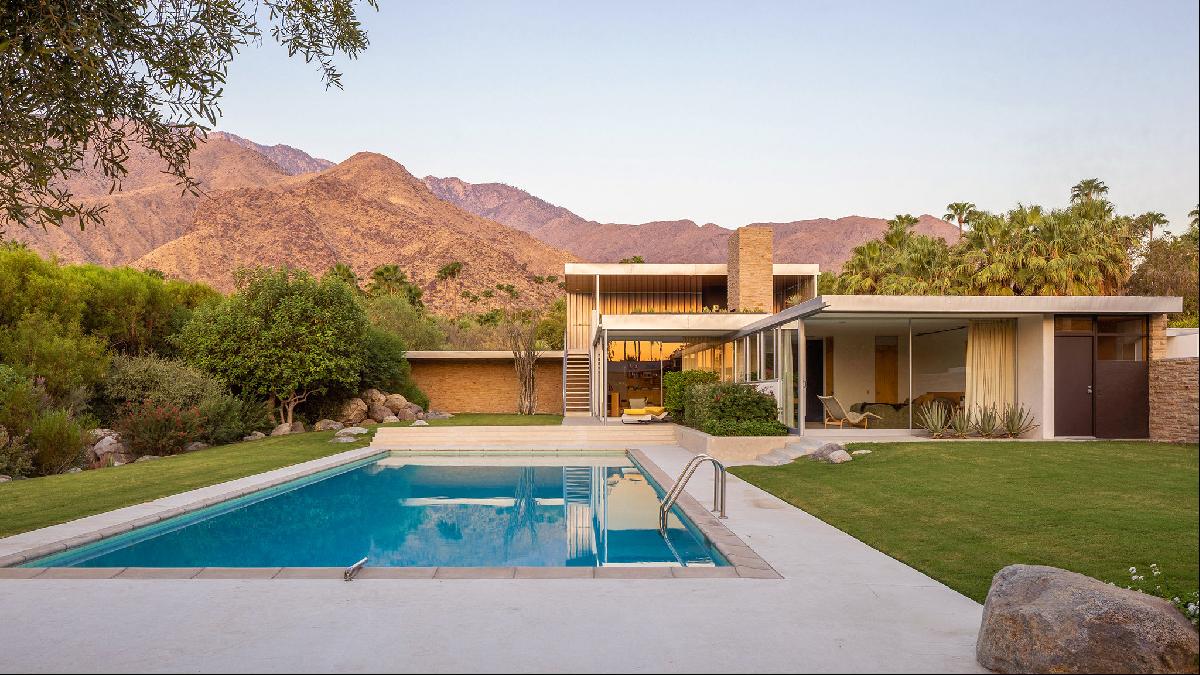
It was initially intended to be a winter retreat for his family from the unforgiving Midwest and East Coast winters, but it ended up becoming one of Palm Springs—and modern architecture’s—most important landmarks. The Kaufmann House is one of the best-known designs by Neutra, a Viennese-born architect who moved to the United States in the 1920s and designed homes for the next few decades for many wealthy West Coast clients. His buildings are seen virtually as the apotheosis of Modernism’s International Style, with their skeletal steel frames and open plans. Yet Neutra was also known for catering sensitively to the needs of his clients, so that their houses would be not only functional but would also nurture their owners psychologically. A handful of his projects are located in Palm Springs, which – thanks to its location two hours east of Hollywood – became a hotbed of modernist architecture during the mid-20th century. Movie stars and celebrities in the 1950s and 1960s hired architects to build contemporary weekend residences that were in vogue at the time.
Future of furniture design
The main outdoor rooms are enclosed by a vertical aluminum fins that offer flexible protection against sandstorms and intense heat. The east wing is connected with the living space of the north wing through a gallery that houses a bedroom suite. This vacation home was designed to emphasize the desert landscape and its harsh climate. Palm Springs, California undoubtedly has some of the most lavish and beautiful homes in North America. A visit there is like being transported back to the Golden Age of Hollywood where you may just find Bing Crosby playing a round of golf or Marilyn Monroe sipping a martini by the pool. The area has remained landmarks of historical, modern architecture, and the Kaufmann Desert House (or simply “Kaufmann House”) is no exception.
Mono-material metal furniture
The resulting time-lapse photo is famous, not only for the multiple images of the running "ghost" puppy, but also for Shulman's request that Lilliane position herself on a mat to block the pool light from over-exposing the photo. Designed by local modernist William F. Cody, the Linsk addition was compatible and relatively seamless, but removed the glass corridor to the master bedroom and drastically reduced the amount of light to the interior. Modernist furnishings selected by Neutra were replaced with those chosen by prominent Palm Springs interior designer Arthur Elrod. It was purchased by Eugene and Francis Klein, owners of the San Diego Chargers, who sold the house in 1973 to entertainer Barry Manilow who owned it until 1993. The house has a cross-shaped plan, with a square living and dining room at the centre, and wings that extend out in cardinal directions.
Architect Richard Neutra's Kaufmann Palm Springs Home Lists for $17M - Robb Report
Architect Richard Neutra's Kaufmann Palm Springs Home Lists for $17M.
Posted: Wed, 23 Jun 2021 07:00:00 GMT [source]
Major outdoor rooms are enclosed by a row of movable vertical fins that offer flexible protection against sandstorms and intense heat. In 1945, Kaufmann acquired a large 200' x 300' (2.6 acre) site that was isolated near the foot of Mt. San Jacinto and studded with rugged desert landscape. His desert house was not designed to blend into the site in the Wrightian style; rather it was to be an object in space in the classical fashion of the European villa. Originally priced as $30,000, (the 3,800 sq. ft. home ultimately cost $300,000) the house turned out to be simple -- and simply expensive. Rectangular in plan, its form was essentially a glass pavilion with planar walls that extended into the site via two axes one north-south -- the other east-west. In this plan, outdoor living areas are sheltered by adjustable walls composed of movable vertical fins that offer flexible protection against sandstorms.
Even though Doe is selling the house the old-fashioned way, by walking prospective buyers through the property one by one, he does not disparage the headline-grabbing method of selling rare houses at public auction. Doe, in fact, says he ran into Beth Harris the day after the auction, and opined he “could not have done a better job of marketing.” When the auction sale fell through, the Harrises turned to Doe. The first effort was a widely publicized auction last year at Christie’s, the New York auction house, where the modernist gem sold for a breathtaking $19.1 million. That kind of fame can have its drawbacks, however, especially for the person in charge of selling a house that nearly everybody, it seems, wants to see. Out of self-defense — and consideration for the owners, who still occupy the residence — Doe came up with a Draconian test to sift the gold from the sand. “I tell them,” he says with the modulated tones of a man who for 30 years has sold houses by big-name architects, “that they can see the house, if they can qualify to pay for it.” The property is listed for $12 million.
Constructed as a series of horizontal planes that seem to float over glass walls, the house seems to absorb the mood of the surrounding desert. The variety of spaces, ranging from enclosed to semi-enclosed to open, transcends any traditional distinction between indoors and outdoors in favor of a continuous, human-made environment. Moreover, the new environment was designed so that its occupants could fine-tune its features for physical comfort, most notably the radiant heating and cooling systems for the concrete surfaces of the outside terraces. Lastly, within the hostile desert surroundings the new environment was to be a safe one as exemplified by the mirrors Neutra installed in unexpected places, which allowed the inhabitants to scan their immediate surroundings. The south wing connects to the public realm and includes a carport and two long covered walkways. These walkways are separated by a massive stone wall and led to public and service entries, respectively.
Neutra responded to the flat site with a pinwheel floor plan whose four wings follow the cardinal directions. The house is entered through the southern wing, which is oriented perpendicular to the street. Visitors first follow a short, irregular pathway that traverses a small, landscaped area with boulders and desert plants.
In 1993, the house’s current owner hired Los Angeles architectural firm Marmol and Radziner to return the house to its original state by relying on many painstakingly researched original materials and production processes. The influence of the Kaufmann House extends beyond its immediate visual and spatial attributes; it has permeated various realms of culture and design. The house has been featured in numerous films, advertisements, and fashion shoots, each time serving as a symbol of stylish modern living and the seamless integration of architecture and nature. Its representation in popular media has played a pivotal role in shaping public perceptions of modernist architecture, portraying it as an ideal of sophistication and modern American lifestyle.
The architect championed the importance of "ready-for-anything" designs that have open, multi-use spaces, and coined the concept "The Changing House" for an article he wrote in 1947 for the Los Angeles Times newspaper. After the Harrises divorced, the home was supposedly sold on May 13, 2008, for US$15 million at auction by Christie's as a part of a high-profile sale of contemporary art. Additionally, the Harrises were able to have a long-closed section of a Utah quarry re-opened to mine matching stone to replace what had been removed or damaged. To help restore the desert buffer Neutra had envisioned for the house, the Harrises also bought several adjoining plots to more than double the land around the 3,200-square-foot (300 m2) house. The Kaufmann House, or Kaufmann Desert House, in Palm Springs, California, was designed by Richard Neutra in 1946.
The war moratoriums were slowly lifted as World War II ended, but relatively strict building regulations remained enforced. However, Neutra was able to find his way around the restrictions by breaking ground on the foundation a few days before the official enforcement. The project resulted in a total cost of nearly $300,000, surpassing the current single-family residence average of $40,000. Neutra’s work is notable for its ability to blur the boundary between inside and outside.


No comments:
Post a Comment