Table Of Content
- architecture in california (
- designboom will always be there for you
- light and air permeate through residence's stacked concrete volumes in philippines
- A Landmark Modernist House Heads to Auction
- History
- roam ranch: baldridge architects designs modern home for rural texas
- richard neutra's iconic kaufmann desert house in palm springs is for sale
- View all galleries in Expo Milano 2015 - All Pavilions
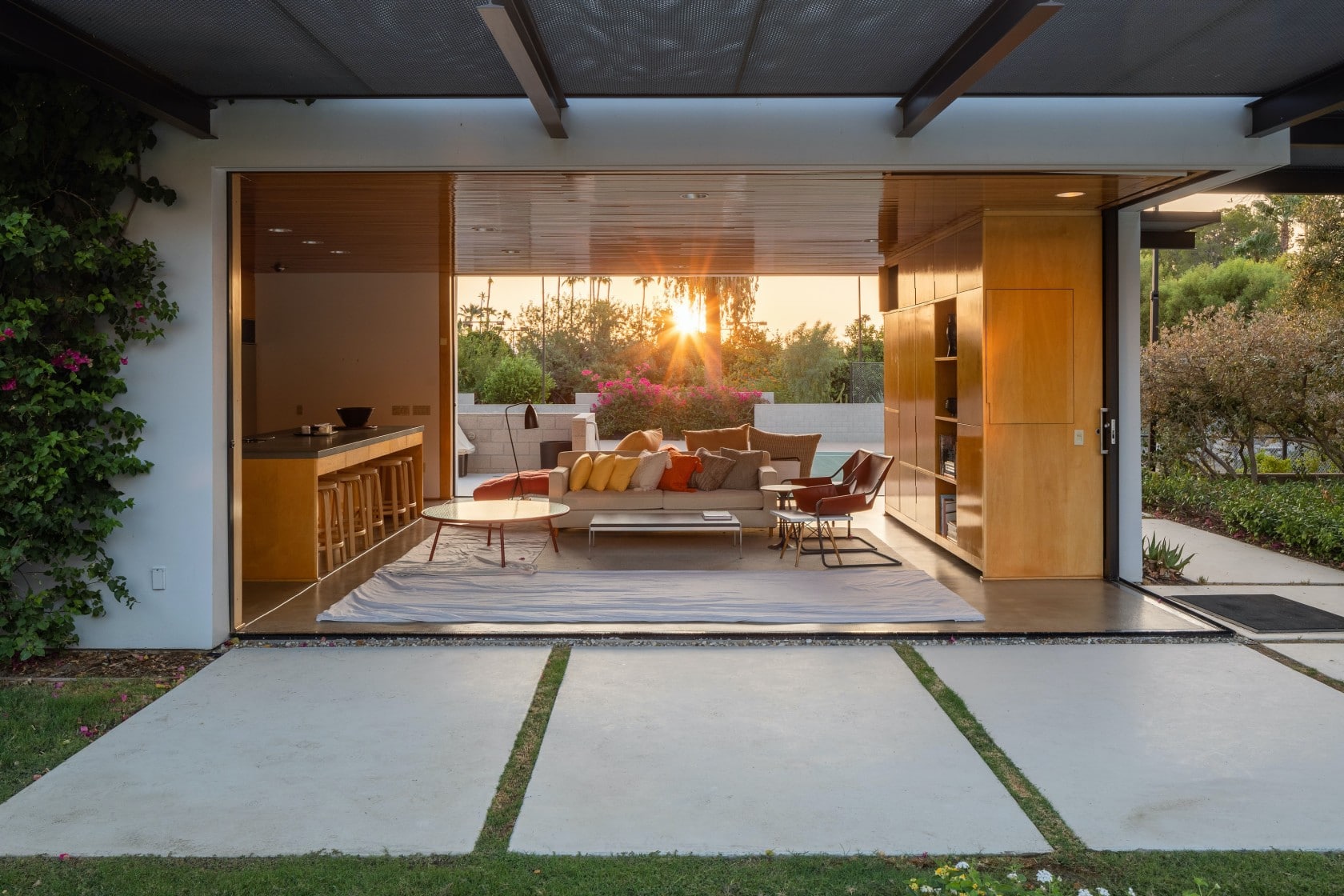
On its left side, the walkway is delineated by a wall faced with dry-set Utah sandstone; a cantilevered roof offers shade. To the right, the view goes across a lawn with interspersed boulders toward an outdoor swimming pool. Behind the sandstone-faced wall Neutra placed a car garage and a secondary entrance into the western wing of the house, which contained the service spaces and servant quarters furthest west. It is one of the most important examples of International Style architecture in the United States and the only one still in private hands. The home was commissioned by Edgar J. Kaufmann Sr., a Pittsburgh department store tycoon as a desert retreat from harsh winters. A decade earlier, Kaufmann commissioned Frank Lloyd Wright to build Fallingwater in Pennsylvania.
architecture in california (
After purchasing the house and its more than an acre of land for about $1.5 million, the Harrises removed the extra appendages and enlisted two young Los Angeles-area architects, Leo Marmol and Ron Radziner, to restore the Neutra design. When the Harrises decided to end their marriage, they faced a dilemma regarding the disposition of the house. Both were clear that the house required a special buyer who would fully appreciate its cultural significance and provide the kind of maintenance such a property requires. They hit upon a seemingly perfect solution -- they offered the house at auction as a piece of art. A precedent had already been set with the 2003 Sotheby's auction of Mies van der Rohe's innovative Farnsworth house which sold for $7.5 million.
designboom will always be there for you
Richard Neutra, a Vienna-born architect, brought a unique blend of European modernism and Californian innovation to his projects. The collaboration between the client and architect was grounded in a mutual appreciation for cutting-edge design and technological advancement, setting the stage for creating a landmark in modernist architecture. Richard Neutra, an emblematic figure of 20th-century Architecture, excelled in blending technology, aesthetics, and the nuances of the natural environment into his designs. Among his illustrious works, the Kaufmann House in Palm Springs, California, is the quintessential example of his approach to modernist architecture. Twenty-five million dollars is certainly a hefty price tag, but then again, the buyer is stepping back into the past, into a profound moment of architectural history. Consider the second-story, open-air gloriette—a French word translating to "little glory"—where views of the San Jacinto Mountains are particularly heady.
light and air permeate through residence's stacked concrete volumes in philippines
To the west is a kitchen and service rooms, accessed by a covered breezeway, with a master bedroom to the east. Built in 1946, the boxy two-storey residence has many defining elements of modern architecture – a flat roof, pale exterior and shaded outdoor spaces – tailored to the arid climate of the California desert. The Kaufmann House is celebrated for its distinctive design, which masterfully integrates the building with its desert surroundings while maintaining a functional elegance.
Through the collaboration of these two individuals, the Hearst Castle emerged out of the hill and would become a landmark for California history and culture of the 20th century. Paul R. Williams was an extraordinary man and a prolific Architect practicing during Hollywood’s Golden age. He worked on a wide variety of projects including churches, airports, public housing, courthouses, and offices; however, he is best known for his luxury custom homes. The case study house program was an experimental program set up by John Entenza through Arts and Architecture Magazine, that facilitated the design, construction and publishing of modern single-family homes.
History
The house is structured as a series of horizontal planes that seem to float against the rugged backdrop of the San Jacinto Mountains. The floor plan is expansive and open, typical of Neutra’s work, promoting a seamless flow between the interior and exterior spaces. Nestled in the foothills of Palm Desert, California, the Annenberg Estate is a stunning example of mid-century modern architecture. Quincy Jones for media mogul Walter Annenberg, the original estate is comprised of 25,000 square foot house on 200 acres. The plan leaves spaces for the courtyards on the periphery of the plan, creating a system of privacy appropriate to the specific occupant in the space; hosts, children, guests, servants, etc.
A handsome southwestern profile composed of vertical stone walls and floating metal planes sits just beyond. From this angle, the structure looks more like an open-air desert pavilion than a home. The home was made to be lived in just 60 days a year (January and February, when the Kaufmanns escaped the Northeast). But after the Kaufmann family sold the estate in 1955, three successive owners — including former Chargers owner Gene Klein and singer Barry Manilow — made changes to make the home more livable year-round. Walls were pushed out, patios were enclosed, surfaces were repainted, air-conditioning was added to the roof, and the original square footage nearly doubled. The updates didn’t stop until 1993, when new owners Brent and Beth Harris, a financial executive and architectural historian, bought the home.

richard neutra's iconic kaufmann desert house in palm springs is for sale

Even designed with right angles, the forms of the house are very smooth; yet the severe winds of northeast Palm Springs still blow everything they can get a hold of, despite improvements to the walls and blinds. The large sliding windows, whose bronze-colored blinds alleviated the silvery glow of the house, lead to an open, adjacent courtyard in the living room and in the master bedroom, open to the pool. Although one wing of the house sits on an east-west axis, the other sits perpendicular or to the cardinal directions to expand the areas of residence. Without the original plans for the house, the Harrises dug through the Neutra archives at the University of California, Los Angeles, looking at hundreds of Neutra’s sketches of details for the house. They persuaded Mr. Shulman to let them examine dozens of never-printed photographs of the home’s interior, and found other documents in the architectural collections at Columbia University.
Where Was Don't Worry Darling Filmed & Can You Visit? - Country and Town House
Where Was Don't Worry Darling Filmed & Can You Visit?.
Posted: Thu, 07 Sep 2023 07:00:00 GMT [source]
The same retail baron commissioned Frank Lloyd Wright to build Fallingwater in Mill Run, Pennsylvania, a decade earlier. The Harrises purchased the home for US$1.5 million, then sought to restore the home to its original design. Neutra died in 1970 and the original plans were not available, so the couple brought in Los Angeles architects Leo Marmol and Ron Radziner to restore the design. They were able to obtain pieces from the original suppliers of paint and fixtures; and they purchased a metal-crimping machine to reproduce the sheet-metal fascia that lined the roof.
Wanting to capture more views at a higher elevation, Neutra designed the gloriette as an open-air perch on top of the house, covered by a roof and shading devices on two sides. Integrating outdoor living spaces and balconies was a consistent theme in Neutra’s past work. The gloriette is accessed from an outdoor flight of stairs that touches down in the central courtyard. The four wings of the structure are accessed through covered breezeways and these contain the kitchen, master bedroom and four other bedrooms. Neutra was known for his designs that blurred the lines between indoors and outdoors and many features of the Kaufmann House reflect this sensibility.
Architects such as Frank Lloyd Wright and Neutra were the first to introduce the style in the United States starting in the 1920’s. However, it wasn’t until after World War II that it saw its rise in popularity, with the escalation of more industrial materials being used in construction. The style was based on the use of new production technologies that generally included steel, concrete, and glass. It also used cleaner, more fluid lines that harmonized with its surrounding environment. This fluid architectural style is what Richard Neutra used to create the Kaufmann House.
Since their restoration of the house (completed in 1995) there have been close to 275 articles about the Harris' efforts and those of their architects, Leo Marmol and Ron Radziner. SAH Archipedia tells the story of the United States through its buildings, landscapes, and cities. This freely available resource empowers the public with authoritative knowledge that deepens their understanding and appreciation of the built environment. Richard Neutra’s Kaufmann House in Palm Springs was designed and built in 1946–1947, although some sources claim that the preparatory contact between client and architect occurred in 1945. The house exemplifies Neutra’s approach to designing a house and its surroundings as a single, continuous environment, a concept he had begun to work with in the early 1940s. Other examples are Neutra’s Nesbitt House (1942, Los Angeles) and the Tremaine House (1945–1948, Montecito).
If walking the rich through Palm Springs’ most exclusive house is a privilege, it is also wistful. The Harrises, who reportedly share the house on alternating weekends, may not be happy about parting with the house they have done so much to preserve. • Neutra did dig the foundations and managed to leave just before they were ordered to halt construction as a result of shortages of materials during the war.
This is particularly evident in the living room, whose walls of steel and glass slide outward toward the southeast, while the construction of deck and supports the hanging wall sliding moving toward the pool and spatially linking the house with it. This radial arm became the hallmark of Neutra, is the “spider leg,” the umbilical cord that merges space and building. After immigrating from Austria, Neutra started his career in America working for a series of well-known architects.


No comments:
Post a Comment